
Minding the Invisible
Or: A belated "hello!" and intro to what I'm doing here

January 18, 2012 — I was a few months into my role as Chief Culture and Talent Officer at the Wikimedia Foundation, and on that day, English-language Wikipedia went dark for 24 hours. In place of articles, every visitor saw a single message: Imagine a world without free knowledge. The mythic distilled to six words.
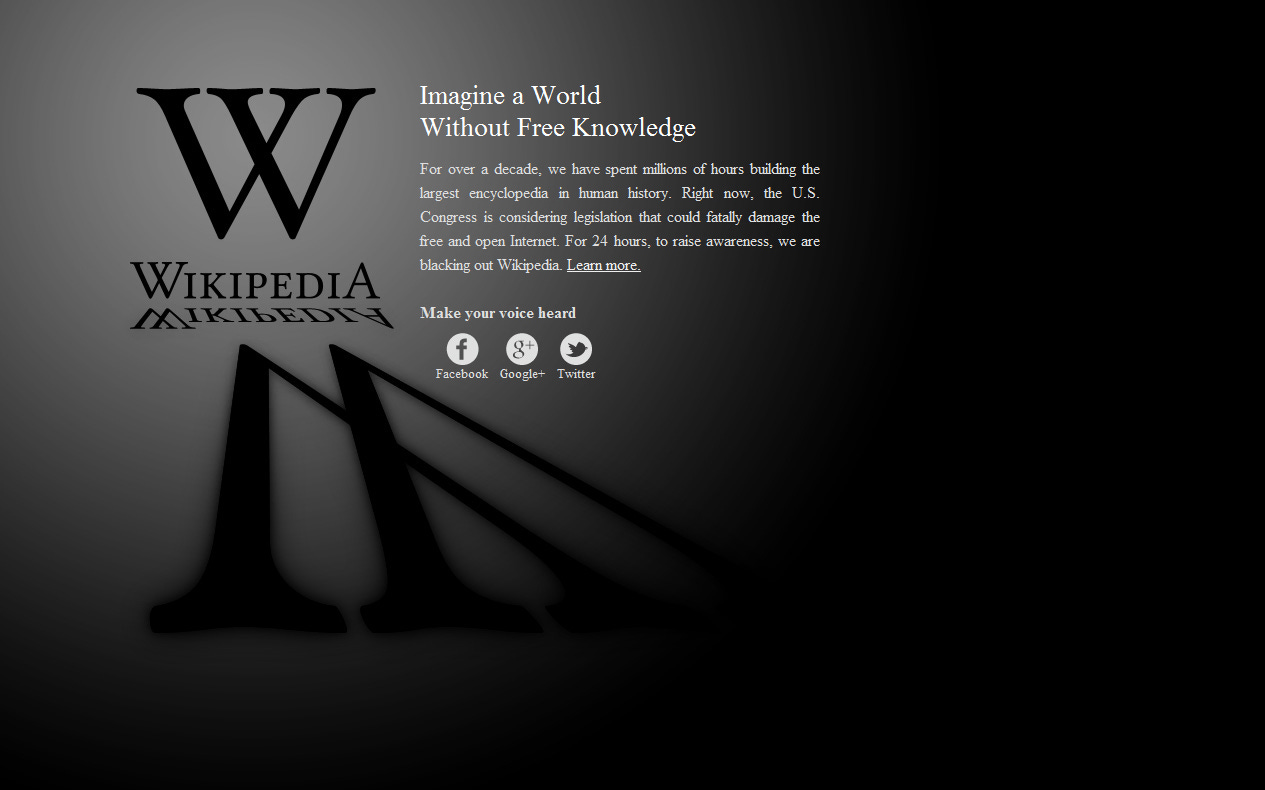
The decision to go dark was made by the Wikipedia community itself — over 1,800 editors participating in what became the largest community discussion in Wikipedia’s history. Before the day ended, political dominoes began to fall. Within days, both SOPA and PIPA were effectively dead.
The beginning of successful cultural leadership is therefore always a small act of creative transgression.
That line comes from Graham Leicester and Maureen O’Hara’s Dancing at the Edge. They go on: it is small because transgression on a larger scale amounts to revolution and will be vigorously resisted. It must be transgressive because in order to shift a culture you must challenge it. And it is creative rather than merely disruptive because it appeals to the culture’s deeper values, its better self.
What the Wikipedia blackout illuminated for me was how culture is built one decision at a time, consciously navigating the mythic and the mundane. Leadership that helps culture evolve accumulates through acts of positive deviance — an idea I picked up from Shawn Quinn when we worked on a leadership development program at Nike together.
How I Got Here
I started experiencing major depressive episodes when I was fourteen, and I was fortunate to come across Viktor Frankl’s Man’s Search for Meaning. Here was a man who knew darkness — and if he could choose his response to the most horrific of human circumstances, then surely I could face the dragons and demons of my own life. I went into psychology fundamentally to find out why all of us are so weird, why we get in our own way, why we are such shits to other human beings, and yet can be so profound and sublime in the way we can interact with one another.
In graduate school, the research lab I worked in was run by phenomenal human beings, Dr. Ricardo Muñoz and Dr. Mimi Le, who were nurturing, smart, driven, supportive, thoughtful, and committed to relationship and community building. Another lab I interacted with was run — from what I could see — by an unpredictable tyrant. The sheer energy wasted by fellow graduate students hiding their research, performing complicated gyrations for some delusion of daily safety, and navigating chaos, made me deeply curious about what it takes to make systems healthier places to be in. There’s a Krishnamurti quote I love: It is no measure of health to be well adjusted to a profoundly sick society. I got curious about how to make collective spaces genuinely well, which led me to leadership.
An old Zen teacher once told me that the practice of Zen is the practice of being one with your own life. I’ve been sitting Vipassana and zazen for twenty-five years (admittedly very sporadically for large stretches), and if this site is anything, it would be this notion of being one with my own life, where the practice meets the living. I’ve joked that I was on my way to becoming a monk when I became an executive instead. Surprisingly, there is less difference between the two than you might think.
When I joined Wikimedia, the all-staff email welcoming me on my first day said, “Welcome to our new ship’s counselor.” (I grew up watching Star Trek with my father, and Counselor Troi — xenopsychologist, empath, a woman on the bridge with an executive function — was someone I wanted to emulate, even though I often say this is a shit time to be an empath and a systems thinker.) Wikipedia radicalized me around free knowledge and instilled a deep commitment to the commons. It also taught me that our ability to have impact through technology has far outpaced our capacity to take responsibility for the unintended consequences.
I’ve been circling this body of work for twenty-five years, in various half-finished manuscripts and talks and coaching sessions and boardrooms. After a difficult personal year of divorce, relocation, transformation, and stepping into a different era of life now that I’ve turned 50, I’ve decided to start capturing some of the hard and beautifully won lessons that have carried me to my fifties.
I’m calling it Minding the Invisible.
Strange questions, yet I have spent worthwhile
time with them. And I suggest them to you also,
that your spirit grow in curiosity, that your life
be richer than it is, that you bow to the earth as
you feel how it actually is, that we- so cleaver, and
ambitious, and selfish, and unrestrained- are only
one design of the moving, the vivacious many.
~ from Mary Oliver
excerpt from “The Moth, The Mountains, The Rivers"
A Thousand Mornings (Penguin, 2012)
What This Site Is
This site is about culture work — the invisible things that shape everything without being acknowledged. It’s also a home for musings, thoughts on travel and encounters with the world, and how I see my ongoing practice of Zen meeting my practice of living.
I imagine this body of work as a series of invitations — into perspectives, into practices, into aspects of leadership and culture that unfold over time because they are lifelong disciplines. Leadership is a lifelong discipline that twines both personal and professional practices, and if you think those two are separate, this is probably not the work for you.
Some invitations I’ll be writing about include: the self as the first instrument of knowing; the widening circles of relational practice; working the mythic and the mundane; dancing with ambiguity; developing an exquisite sense of timing; tending endings; creative transgression as a practice; and the imperative to cultivate discernment in a world optimized for its opposite.
These are lenses, not sequential chapters, there’ll probably be a lot of detours and photos of my dogs. You can pick up any of them and look through it at whatever is in front of you. That’s how I’ve been using them for twenty years.
The AI Posts and What’s Next?
The AI posts that preceded this “intro” were, in a strange way, the most immediate version of this same argument — that we are investing enormously in visible, measurable, deployable tools, and almost nothing in the interior capacities that determine whether those tools serve or diminish us. The question I kept asking about AI — who do you need to be to partner well with this technology? — is the same question I’ve been asking about leadership and culture for decades. The swirl and current preoccupation with this technology, especially now that I’ve moved back to Silicon Valley, made the topic more obvious, and probably more likely to be read.
So if you came here from the AI series: welcome. This is the larger project it was always pointing toward.
Coming up: posts on culture as dark matter, the mythic and the mundane, making the undiscussable discussable (with gratitude to Chris Argyris who I trained with years ago), and the role of coherence in organizational life.
Welcome to Minding the Invisible.
Hi Gayle tasting your posts is like a butterfly going for one flower to another, enjoying the nectar and then depositing it in a honeycomb for to be digested later as a sweet treat. Your psychology and Zen yearning and study is an interesting treat for a a Sufi student practicing for five decades.
"Wherever you go, east, west, north or south, think of it as a journey into yourself! The one who travels into itself travels the world
. A life without love is a waste. “Should I look for spiritual love, or material, or physical love?”, don't ask yourself this question. Shams of Tabrize ( Rumi's teacher)
I was particularly struck by your struggle to protect yourself from the indulgence in AI and the impact on the soul
I've experienced its capacity to scour Sufi texts, teaching stories and Masters insights and match the patterns to situations in my life and reflect insights that harmonize with that of a teacher's reflection.
Shocking! Scary but being Conscious Is developing the capacity to stand outside yourself. Observe your patterns, blind spots, assumptions and then respond.
I chose to apply AI to unlock my limited cognitive capacity and use it to amplify opportunities ....to move from a world of binarybhinking to a world of quantum choices., particularly in the world of business decision making where for generations, the world's been governed by leaders who choose profit and stakeholder value over purpose and values-based decisions.
AI unlocks the opportunity to move from "optimization to harmonization" in decision making, which gives us AI, THE new thinking partner , allowsing us to anticipate and harmonize the impacts on all stakeholders, which could eventually translate into a sustainable outcomes and Regenerative future.. note the AI Unlock.
https://irakaufman2.substack.com/p/the-ai-unlock?utm_source=share&utm_medium=android&r=brimh
Just depositing some nectar on your growing honeycomb... to see where it lands and what messages come back
😊🙏